
Does Classical Education Actually Work? A Look at Student Achievement Data
When parents walk into a classical academy, they often see things that look a bit "old school." There are physical books instead of tablets, students are practicing cursive, and the walls might be adorned with maps and timelines rather than the latest pop-culture posters. It’s natural to ask: Does this actually work in the 21st century? In an age dominated by high-stakes testing and a push for ever-more classroom technology, does returning to the "Great Books" and the Trivium actually prepare a child for a modern career?
The short answer is a resounding yes. But you don't have to take our word for it. When we look at classical education student achievement data, the numbers tell a story of high performance, deep critical thinking, and long-term success. At Cornerstone Preparatory Academy, we’ve built our model on these proven pedagogical foundations, offering a tuition free classical charter academy option for families in Bay County who want results that go beyond a simple letter grade.
The Evidence: Breaking Down the Standardized Test Scores
While classical education focuses on forming the whole person, mind, body, and soul, it also happens to produce students who excel at standardized testing. For many parents, the PSAT and SAT are the primary benchmarks for academic success.
Research comparing students in classical environments to those in traditional public or private schools shows a "statistically significant difference" in performance. Specifically, students in classical schools consistently outperform their peers in reading, math, and writing. According to data comparing graduates of the Association of Classical Christian Schools (ACCS) to other educational models, classical students often score well above the national average.
Why does this happen? It’s not because classical schools "teach to the test." In fact, it’s quite the opposite. By focusing on a knowledge-rich curriculum and the development of language skills through the study of Latin and classic literature, students develop a higher level of reading comprehension and vocabulary. When they sit down to take the SAT, they aren't just recognizing test patterns; they are actually understanding the structure of the language and the logic of the arguments presented.
Moreover, the math performance in classical schools is bolstered by a focus on the why behind the numbers. Instead of rote memorization of formulas, students are taught the logical foundations of mathematics. This leads to a deeper proficiency that naturally translates to higher scores on standardized assessments.
The "Good Soil" Study: Measuring Long-Term Impact
If you really want to know if an educational model works, you have to look at what happens after graduation. This is where the "Good Soil" study comes in. This comprehensive research project looked at the life outcomes of young adults who attended classical schools versus those from traditional public, private, and homeschool backgrounds.
The study measured seven key areas, including college and career readiness, independent thinking, and the capacity to influence others. The results were striking:
College and Career Readiness: Classical graduates reported feeling significantly more prepared for the rigors of university-level work. They possess the study habits and writing skills that many modern college professors find lacking in today's freshmen.
Independent Thinking: In an era of "groupthink," classical students are trained in the Art of Logic. They are taught to identify fallacies and construct sound arguments, making them less susceptible to social pressure and better at objective analysis.
Influence and Leadership: The study found that classical graduates are more likely to hold positions of influence and demonstrate a higher commitment to civic virtue.
For a k-8 classical school like Cornerstone Prep, these findings are foundational. We aren't just looking at how a third-grader performs on a state test; we are looking at how that child will lead their community twenty years from now. You can discover more about our approach here.
Why the Pedagogy Works: The Trivium
To understand why the data is so positive, you have to understand the pedagogy. At Cornerstone, we utilize the Trivium, a three-stage process that aligns with a child’s natural cognitive development. Even though we are a public charter school and not a religious institution, we lean heavily into these "ancient" methods because they are psychologically sound.
The Grammar Stage (K-4): At this age, children naturally love to memorize. We lean into this by filling their minds with the "grammar" or foundational facts of every subject, phonics, math facts, historical dates, and scientific classifications. By building this massive storehouse of knowledge early, we give them the tools they need for higher-level thinking later.
The Logic Stage (5-8): As students enter their middle school years, they naturally become more argumentative (as any parent of a 12-year-old knows!). In a classical model, we don't stifle that; we channel it. We teach them formal logic. They learn how to argue well, how to spot inconsistencies, and how to connect the facts they learned in the Grammar stage.
The Rhetoric Stage: While Cornerstone currently serves K-8, the goal of the Trivium culminates in Rhetoric: the ability to express oneself with grace, clarity, and persuasion.
By following this model, we avoid the pitfalls of modern education, which often tries to force "critical thinking" before a child has the "facts" to think about. You can’t think critically about the Civil War if you don't know when it happened or who the key players were. Classical education ensures the foundation is laid first.
Modern Tech vs. Classical Tradition
A common critique is that classical education is "anti-technology." That’s a misconception. At our Explorers Institute, we integrate STEM and robotics, but we do so through a classical lens.
We believe that technology should be a tool for the mind, not a replacement for it. Recent observations in the educational sector have noted a "troubling trend": as classrooms become more dependent on screens, student proficiency in reading and deep concentration has stagnated. We’ve discussed this in depth in our post on how classroom technology can sometimes fail students.
By prioritizing human-to-human discussion, physical books, and hands-on experiments, we ensure that our students develop the focus and cognitive endurance required to succeed in high-tech fields. The student achievement data supports this; students who can read deeply and think logically are far better at coding and engineering than those who have merely learned to navigate an iPad interface.
Bringing Classical Excellence to Bay County
For a long time, this level of education was only available at high-tuition private schools. Cornerstone Preparatory Academy was founded to change that. As a tuition free classical charter academy, we are bringing this high-standard, data-proven model to every family in Bay County.
Whether you are looking for a substitute teaching position or are a parent seeking a math and science curriculum that actually challenges your child, Cornerstone provides a community built on Wisdom, Knowledge, and Virtue.
We believe that every child deserves a "knowledge-rich" education. When you look at the classical education student achievement data, it becomes clear that this isn't just a "nostalgic" way to teach: it is an effective, rigorous, and empowering way to prepare children for the future.
Practical Steps for Parents
If you’re interested in seeing how these results can manifest in your child’s life, here are a few ways to get started:
Encourage Deep Reading: Swap 30 minutes of screen time for 30 minutes of reading a "living book" (a classic story or a well-written biography).
Support Logic: When your child asks "why," don't just give the answer. Lead them through the logical steps to find it themselves.
Investigate the Data: Look into the SAT/ACT averages for classical schools compared to your local district. The gap is often eye-opening.
Visit Us: Schedule a phone meeting with our Head of School to discuss how our K-8 model fits your child’s needs.
Conclusion
The data is in: classical education works. It works for standardized tests, it works for college preparation, and most importantly, it works for life. By focusing on the timeless tools of learning: the Trivium: Cornerstone Preparatory Academy is ensuring that our scholars are not just "test-takers," but thinkers and leaders.
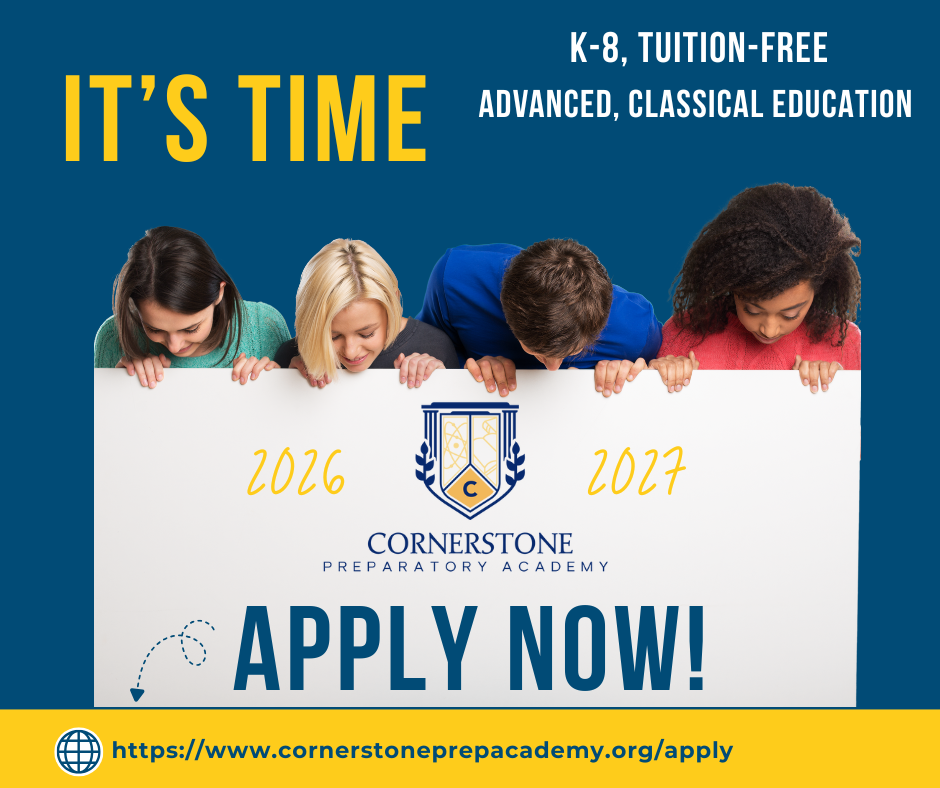
Applications for the 2026/2027 school year are open. Join us in Bay County as we build a foundation of excellence, one student at a time. Visit our blog for more insights, or start your application journey today.
